
An official-looking report is useful only if the sample, methods, laboratory and regulatory references actually belong to the cargo and support the claimed result.
The transaction narrative placed loading in Oman. The submitted report instead states “Location: Ust Luga (Ru)”, identifies “AMANAT PETROL LAB” as the inspection party and presents a 70,236 MT granular sulphur lot. We tested the document as evidence — not by appearance, but by asking whether its sampling location, test methods, accreditation identity and regulatory references were independently supportable.
The key question was whether this report independently established quality and provenance for the cargo being offered.
| Ref | Evidence / source | Source class | What it tests | Finding | Status |
|---|---|---|---|---|---|
| E01 | Submitted laboratory report | Submitted Evidence | Sampling provenance | The document states “Ust Luga (Ru)” and “Silo 4,5”, while the transaction narrative placed loading in Oman. | CONTRADICTED |
| E02 | Report result table | Submitted Evidence | Measured cargo quality | The table shows specification limits but no separate measured-result column. | NOT ESTABLISHED |
| E03 | Published ASTM method scopes | Official / Primary | Method suitability | Multiple cited methods belong to coal, carbon black, solvents or aromatic hydrocarbons rather than elemental sulphur testing. | CONTRADICTED |
| E04 | Laboratory identity / accreditation | Required / Independent | Competence and traceability | An ISO/IEC 17025 accreditation number, accredited scope and traceable laboratory identity were not established from the reviewed evidence. | NOT ESTABLISHED |
| E05 | CU TR 013/2011 official scope | Official / Primary | Regulatory citation | The regulation concerns specified fuel products; it is not a “dry bulk” sulphur regulation. | CONTRADICTED |
| E06 | Fresh load-port inspection + chain of custody | Required Evidence | Transaction-specific quality proof | A new, traceable load-port inspection is required before the report can be replaced by transaction-specific evidence. | REQUIRES EVIDENCE |
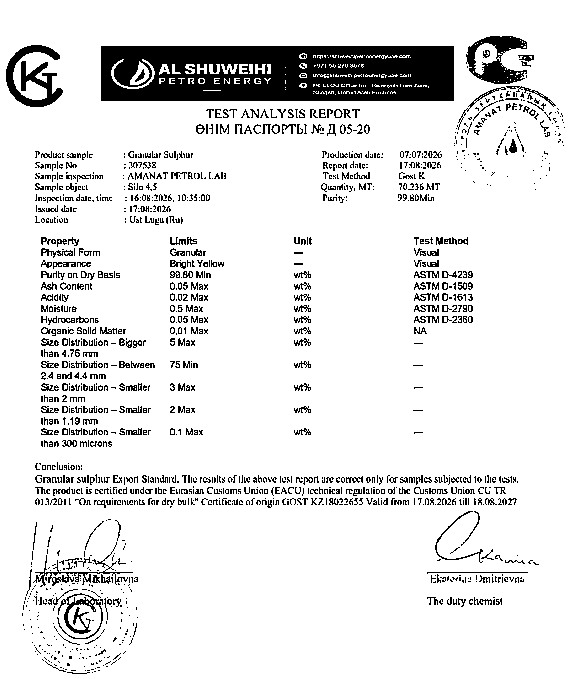
The table is headed Property · Limits · Unit · Test Method. Values such as “99.80 Min” and “0.05 Max” are specification limits; the document does not show a separate measured result for each property.
The report states “Sample object: Silo 4,5” and “Location: Ust Luga (Ru)”. That is not the stated Oman loading chain. A test can only support this cargo if the sampling and custody link to the cargo are established.
The report names “AMANAT PETROL LAB” but does not state an ISO/IEC 17025 accreditation number, accreditation body, accredited scope or traceable laboratory address. Public exact-name checks did not establish a Russian accredited laboratory under the stated name.
The conclusion describes CU TR 013/2011 as “On requirements for dry bulk”. The actual regulation concerns motor and aviation gasoline, diesel and marine fuel, jet fuel and fuel oil — not granular sulphur.
The problem is not that an ASTM number appears on the page. The question is whether the cited method is actually intended for the material and property being reported.
| Report property | Cited method | Official / published method scope | Assessment |
|---|---|---|---|
| Purity on dry basis | ASTM D4239 | Sulfur in analysis samples of coal and coke by high-temperature combustion. | Matrix mismatch |
| Ash content | ASTM D1509 | Heating loss of carbon black at 125°C. | Property and matrix mismatch |
| Acidity | ASTM D1613 | Acidity in volatile solvents and chemical intermediates used in paints / related products. | Matrix mismatch |
| Moisture | ASTM D2790 | Historical method for analysis of solvent systems used for removal of water-formed deposits; withdrawn in 1993. | Unrelated / withdrawn |
| Hydrocarbons | ASTM D2360 | Trace impurities in monocyclic aromatic hydrocarbons such as toluene / mixed xylenes by gas chromatography. | Matrix mismatch |
The report states that the product is certified under the Eurasian Customs Union regulation CU TR 013/2011 “On requirements for dry bulk”. Public regulatory records identify CU TR 013/2011 as the technical regulation for automotive / aviation gasoline, diesel, marine fuel, jet fuel and fuel oil. The title and scope quoted in the report therefore do not match the actual regulation.
The same conclusion also refers to a “Certificate of origin GOST KZ...” without identifying an issuing authority or providing the underlying certificate for verification. That claim was therefore treated as not established, not as proof of origin or conformity.
Evidence discipline: this case does not require an allegation that the document was fabricated. The defensible conclusion is narrower and commercially sufficient: the submitted report did not establish cargo quality, sampling provenance or accredited independent inspection for the transaction.