
A real tanker and credible historical documents can prove past activity without proving that today’s presenting party owns, controls or is authorized to sell the current cargo.
This case shows why asset verification and counterparty verification must remain separate. A genuine ship and authentic-looking historical cargo records can still be used inside a transaction that the presenting party has no proven authority to execute.
This review separated three questions that are often wrongly merged: is the asset real, is the history credible, and does the current counterparty control the transaction?
| Ref | Evidence / source | Source class | What it tests | Finding | Status |
|---|---|---|---|---|---|
| E01 | Independent vessel registry / database | Independent Operational | Physical vessel existence | Type, capacity, operating status and core registry characteristics supported a real tanker in active service. | VERIFIED |
| E02 | Historical B/L, manifest and survey set | Submitted Evidence | Past performance | The historical cargo package was commercially coherent as a past-performance record. | SUPPORTED |
| E03 | Document-control marking | Submitted Evidence | Current vs. historical relevance | The source package itself identified the material as past-performance showcase rather than proof of a live cargo. | VERIFIED |
| E04 | Current ownership / management cross-check | Independent Operational | Present control chain | Current vessel-side ownership / management did not form a clean bridge to the presenting party. | NOT ESTABLISHED |
| E05 | Current title / seller authority | Required Evidence | Right to sell or control cargo | The reviewed evidence did not establish present title or authority to execute the offered transaction. | NOT ESTABLISHED |
| E06 | Beneficiary / payment-chain evidence | Required Evidence | Who receives funds and why | Current authority and payment relationship must be independently tied together before commitment. | REQUIRES EVIDENCE |
Vessel type, capacity, operating status and core registry characteristics were consistent with a real crude-oil tanker in active service.
The document set included a bill of lading, manifest, quantity / quality certificates, inspection records and cargo-survey material. Product characteristics were broadly consistent with the crude grade described.
Current vessel ownership / management information and the party presenting the transaction did not align cleanly with the historical document-side chain. The evidence did not establish current title or authority to sell.
The document package itself stated that it was for past performance showcase rather than proof of a current live cargo. Current vessel records also showed a different ownership / management profile from the historical transaction documents.
Risk implication: genuine historical documents can be reused to create a highly convincing commercial story. Without current authorization, title and payment-chain verification, the buyer may be dealing with a party that does not control the transaction at all.

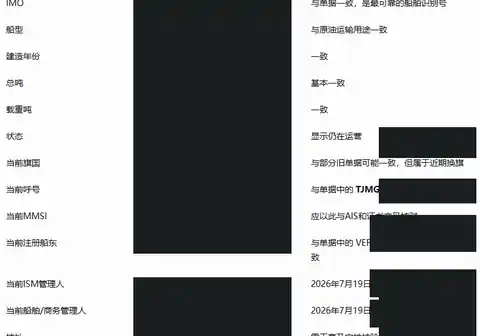
Yes. Independent registry and vessel data supported the existence and operating profile of the tanker.
Historically credible. The documentation formed a coherent past-performance record, but it was not evidence of present title or control.
Not proven. The current ownership / management and authority chain could not be reconciled to the party asking the client to proceed.
Privacy note: names, IMO number, dates, counterparties and route-specific identifiers are intentionally omitted from this public case study.